
MILOEK
Militärökonomische Forschung und Lehre
Research and Courses in Economics of Defense


E
Online: * August 2012


Economics and the Economics of Defense V
Textbook economics regularly assumes that economic activities in societies are happening in peaceful settings. However, as we can observe each day in gruesome detail, aggressions in societies as well as aggressions between societies seem to pay off ─ at least, for the decision makers behind the aggression. The economics of defense offer an explanation why many aggressions seem to have a “rational” background:
- Economic transactions require the voluntary commitment of the participants.
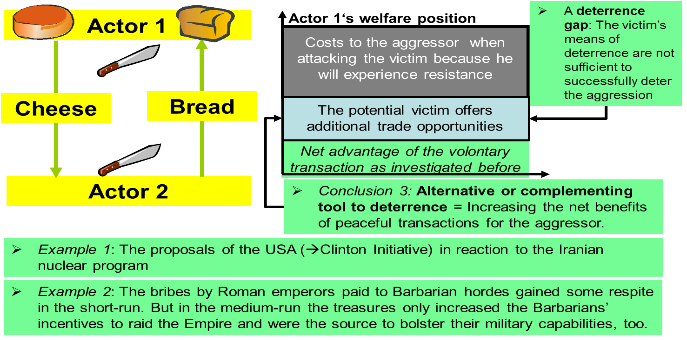
- This means that ─ at least ex ante ─ the actor hopes to improve his welfare position by entering a transaction. Thus, economic transactions are based on the principle of “Do ut des.”
- In contrast, aggressions or threats seek to force the aggressor’s will on the victim ─ refer to Clausewitz (1832). The aggressor’s motive: This action allows him to acquire the resources of the victims with no need to compensate them for their losses.
- Consequently, the investment in “tools of aggressions” may pay off ─ as long as the victims are not able to offer resistance, which would make the road of aggression sufficiently unattractive. I.e, deterrence works because it increases the costs of the aggression to a prohibitive level: Si vis pacem, para bellum.

forward

back
First Version: September 2012
This Version: November 2012