
MILOEK
Militärökonomische Forschung und Lehre
Research and Courses in Economics of Defense


E
Online: * August 2012


A Unifying Perspective III
Due to these implications, a SoME can rightfully claim to be the best economic system generating performance and social security under realistic conditions. However, it still faces a significant number of challenges.
|
10.
|
The human restriction of bounded rationality leads (inevitably?) to phenomena like the winner’s curse or herd behavior. This may result in economic crises affecting individuals, groups or even whole societies ─ particularly, when the actors are confronted with new technologies or, generally speaking, changing social or environmental conditions.
|
|
11.
|
To certain actors it may pay off to explicitly or implicitly violate the social contract.
|
|
n
|
For example, robbery by individuals, by groups or by social movements can represent an “attractive” option because the voluntary transactions in a market economy always require compensations.
|
|
n
|
The main difference between politically motivated aggressions and criminal acts is that terrorists or an totalitarian society engaging in wars of aggression claim to follow ideological reasons ─ i.e., they claim that the current social order of the attacked state is oppressive etc. But the previous pages should have made clear why cynic slogans like “Our freedom fighters are your terrorists.” or “Right or wrong, my country.” are most of the time wrong:
|
|
○
|
A freedom fighter is someone who tries to establish a democratic society based on the two universal principles and he started / joined the fight because he can credibly claim he had no other choice to change the order.
|
|
○
|
In contrast, a terrorist seeks to destroy a society that is (approximately) based on these principles.
|
|
○
|
Nonetheless, the problem of identifying who is who often remains under real conditions: For example, in Syria a dictatorial regime is currently engaged in a civil war where major resistance comes from Islamistic groups denying equal rights to other religions, to females etc.
|

forward

back
First Version: October 2012
This Version: November 2012


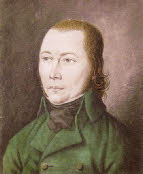
Johannes Bückler
alias “Schinderhannes”
(*1779 †1803)
alias “Schinderhannes”
(*1779 †1803)