MILOEK
Militärökonomische Forschung und Lehre
Research and Courses in Economics of Defense


E
Online: * August 2012




forward

back
First Version: April 2015
This Version: April 2015
This Version: April 2015

|
n
|
Cluster 1: All rational war designs (↔ morally justified designs) share certain features. The latter exist on one hand, because the physical and mental capabilities of man as well as their natural environment have only slowly changed in the last 10’000 years. On the other hand, rational war can be characterized ─ in accordance with an updated Clausewitzian understanding of war ─ as a specific type of coordination mechanism. All common features are assembled in the so-called “core of war”.
|
In contrast, the remaining five clusters encompass the main forces that cause each war to be a unique constellation.
|
n
|
Cluster 2: The social, economic, cultural, political and natural features of societies – the latter represent the associations that employ war as an instrument of coordination and they provide the corresponding resources to wage war.
|
|
n
|
Cluster 3: There exist four different classes of war goals providing the incentives for societies to use war as a coordination mechanism.
|
|
n
|
Cluster 4: The types of players employed to achieve the tactical, operative and strategic goals in violent combat: Conventional forces, special forces and irregulars. These forces are complemented by civilian players supporting the war effort ─ for example, by seeking to win the “hearts and minds” of participating populations.
|
|
n
|
Cluster 5: The two basic principles of war – war of attrition and surprise attack – that must be applied to produce any impact on enemy forces.
|
|
n
|
Cluster 6: The rules of engagement that define the behavior of players towards combatants and civilians.
|
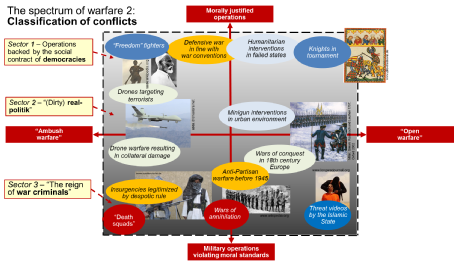
The second chart offers an attempt to arrange the spectrum of warfare by focussing on two dimensions: The moral justification for military operations and the general type of warfare applied in these operations.